

3 Substack Note Mistakes Writers Make Every Single Day
Here’s How To Fix It


Notes is the most powerful feature on Substack right now.
I don’t say that lightly. It’s the only place on the platform where you can put your writing in front of both your existing readers and people who have never heard of you.
Long-form newsletters stay in the inbox. Notes travel.
And because Notes are short-form, readers engage without judging you first. They don’t check how many subscribers you have before deciding if your words are worth their time. A Note that resonates, resonates. That’s it.
I experienced this firsthand.
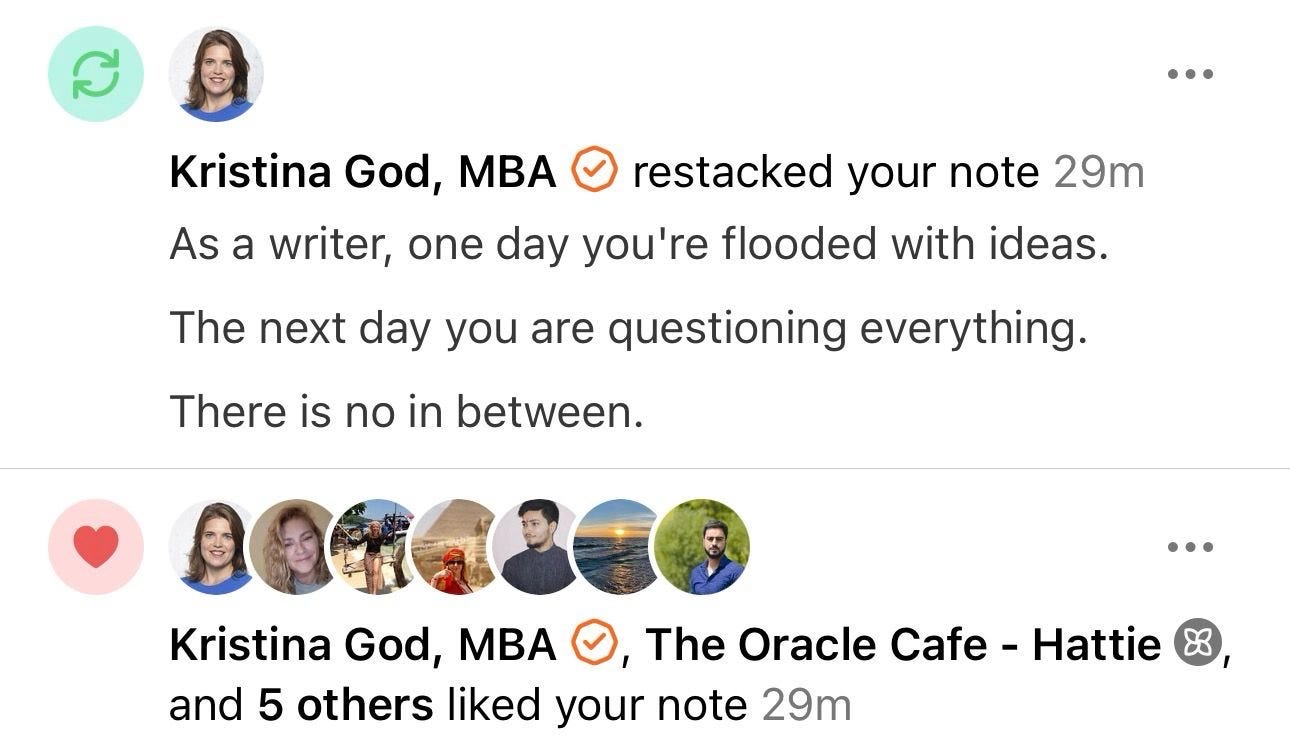
Kristina God — a writer with thousands of subscribers — reacted to one of my Notes and even restacked it. At the time, I didn’t even have Fifty subscribers. That one moment told me everything. You don’t need to be a top writer to get the attention of another top writer. You just need to write something that hits.
So if you’re not using Notes, you’re leaving subscribers on the table.
Here are three mistakes I made which I see Substack writers make every single day.
Mistake #1: Not Building Your Note Bank
Think of a Note Bank the way you think of a savings account.
You don’t spend every dollar the moment it comes in. You save for the rainy day. The day when you’re broke on ideas and motivation has completely left the building. A Note Bank works the same way. It’s a collection of pre-written Notes you build on your best days — so you’re never scrambling on your worst ones.
Here’s the truth — you will not be inspired every single day.
You will not always be able to sit down and write something valuable on the fly. But there will be one day in the week where everything clicks. Ideas come fast, energy is high, and you could write ten Notes before lunch. That day is your deposit day.
Don’t waste it.
Use that window to write as many Notes as you can and store them. The more you stockpile, the more prepared you are for the days and weeks ahead when life gets in the way but you still need to show up. Notes that come from a bank are just as good as Notes written in the moment. Your readers can’t tell the difference. But your subscriber count will. Consistent Notes earn you subscribers like nothing else on the platform. Think of your Note Bank as an investment in your Substack.
The ROI shows up as growth.
Mistake #2: Skipping the Daily Schedule
One Note a day is not enough.
Two Notes a day is the minimum that actually moves the needle, especially when you’re starting out and building from scratch. One Note gets lost. Two Notes give you twice the surface area to be discovered.
Now I know what you’re thinking.
Posting two Notes every single day sounds exhausting. It doesn’t have to be. Once your Note Bank is built, this becomes a scheduling task, not a writing task. Substack’s native scheduler lets you set your Notes for a specific date and time in advance.
You don’t need to be online.
You don’t need your browser open.
You don’t need to remember to log in at the right moment.
That’s how it used to work with older third-party tools.
Not anymore.
Now you can sit down once a week — or once a month if you’ve got a fat Note Bank — schedule everything out, and let Substack handle the rest. Two Notes a day, consistently, without burning yourself out.
This is the compounding effect of preparation.
You build the bank.
You set the schedule.
You show up in your readers’ feeds every day without even thinking about it. And that consistency is what gets you seen by your existing readers and by new ones who are just discovering you.
Mistake #3: Not Promoting Your Notes
Building a Note Bank and posting daily is only half the job.
Your Notes are not going to land on every reader’s feed automatically. The algorithm decides what gets shown and to whom. You can’t leave your reach entirely in its hands. You have to actively put your Notes in front of people.
The first place to start is your own channel.
Every Substack publication comes with its own channel — you’ll find it inside Substack’s chat functionality, listed under your publication name. Sharing your Notes there keeps the channel alive and reminds your existing subscribers that you’re active. Personally, I haven’t seen this drive massive growth, but it costs you nothing and it signals consistency to the readers who are already in your corner.
The bigger opportunity is other people’s channels.
Specifically, top creators in your niche.
A few Substack channels/newsletter publications worth exploring —
How to Write for a Living
The Irresistible Writer
Write Build Scale
These communities are full of writers and readers who care about the same things you do.
If you’re a paid subscriber of a particular creator, you often get the ability to start a thread in their channel. Use it thoughtfully.
Drop a Note
Share something valuable
Spark a conversation but don’t spam.
Treat other people’s channels with respect.
Follow the community rules and honour the space the creator has built.
Finally, restack your own Notes — especially the ones that didn’t perform the first time. Pull a strong line from a long-form article. Take a Note from your archive that deserves a second shot. Restacking gives older content a new life without writing anything from scratch. It’s one of the most underused moves in a beginner writer’s toolkit.
Notes are not a nice-to-have on Substack. They are the growth engine.
Build the bank.
Set the schedule.
Promote like it matters.
Because it does — especially when you’re still under 100 subscribers and every single one counts.
I analyzed 75 high-performing “spike” Notes across 10 writers.
Here are 5 types of Substack Notes that works — with templates — in a Playbook for Substack writers wanting more subscribers.
Get Your Copy Now!