

3 Steps to Turn Substack Notes Into a Free Market Research Tool
Here’s How Smart Substack Writers Never Run Out of Content Ideas


Most people think Substack is just a newsletter platform.
you write
you publish & send
your subscribers read
That’s it.
But that’s not the full picture.
Substack is an ecosystem. It is a podcast. It has short-form video, like Instagram Reels or YouTube Shorts. It has a long-form publication feature. And it has a short-form notes feature — think Twitter, but for writers.
Within that ecosystem, the feature I use the most is Substack Notes. I post short-form content there every single day. And I do it for one reason: to figure out what my next article should be.
This exact headline? It started as a Note. It performed well. Now it’s an article.
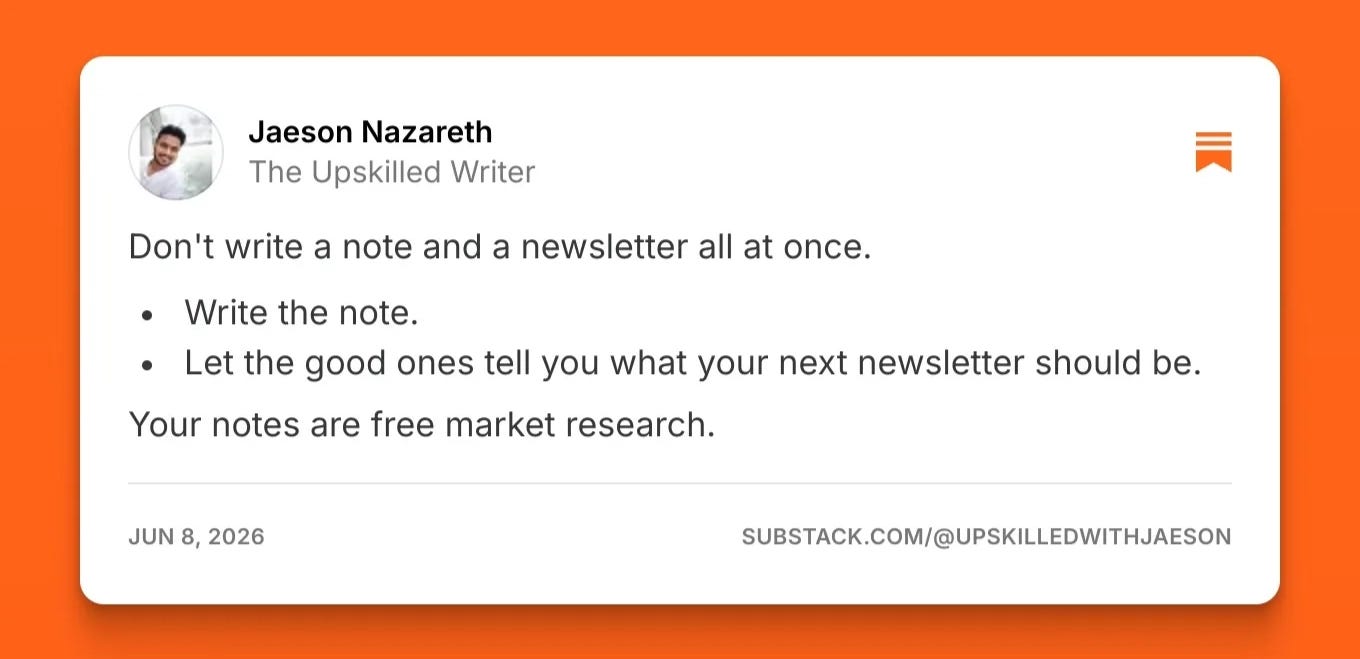
Here’s how you can do the same.
Step 1 — Build the Bank
To post Notes daily, you first need a stash of ideas to pull from.
That’s your note bank.
The Notes I’m talking about are short-form ideas — a sentence, a take, an observation. Something small enough to post in under a minute, but meaningful enough to make someone stop scrolling.
Three ways to build this bank:
Study top creators. Find writers already posting Notes consistently. Look at their best-performing ones. What’s the structure? What’s the hook? Extract the template and write your own version from it. You’re not copying — you’re learning the format.
Reply to other people’s Notes. See a Note that sparks a reaction in you? That reaction is your idea. Take their point, layer your own perspective on top, and post it as a standalone Note. You’ve just turned someone else’s thought into original content.
Mine your long-form articles. If you’ve already written essays or newsletters, there are dozens of short ideas buried inside them. Pull them out. A single paragraph can become a Note. A counterintuitive sentence can become a Note. Your existing work is a goldmine you haven’t fully used.
Once the bank is built, use Substack’s scheduling feature to publish at least two to three Notes every day.
Consistency is what generates the data you need for the next step.
Step 2 — Look for the Signal
After a month of posting 2 notes a day, you’ll have roughly sixty published Notes.
Out of those sixty, twenty to thirty will have outperformed the rest.
Your job is to find them.
There are two ways to do it:
Look at the numbers. Lets say, if your average Note gets zero to two likes, any Note that pulls in five, ten likes, or a handful of comments is a spike Note. Flag it. That kind of response means something landed — and it’s worth exploring further.
Read the comments. This one matters more than most people realise. Sometimes a Note gets one like and one comment. On paper, it looks like it flopped. But if that comment says “this changed my perspective” — that’s a spike Note. The algorithm may have buried it, but the reader found it valuable enough to tell you. That’s signal. Don’t ignore it.
Every week or two, go back through your older Notes. You’re not just looking at likes. You’re looking for proof that something resonated — whether the platform amplified it or not.
Step 3 — Write Your Next Long Form
You’ve found your spike Note. Now the work is simple: expand it.
Turn it into a Substack newsletter. Write it up as a long-form Medium article. Record it as a YouTube video. The format matters less than the fact that you already have proof people care about the topic. You’re not guessing anymore. You have validation.
Don’t overcomplicate this.
The content ladder looks like this:
Your best-performing Note becomes your next article.
Your best-performing article becomes your next digital product.
Your best-performing digital product becomes your service offering.
It all starts with a simple Note
Mark Manson did a version of this.
Before The Subtle Art of Not Giving a F*ck was a bestselling book, it was a blog post. That post did well which was the validation he needed. Then he wrote the book. He didn’t guess what his audience wanted. He already knew.
You can do the same thing at your scale.
Let your Notes tell you what to write.
Let the signal guide you.
The research is free.
All you have to do is pay attention.
I analyzed 75 high-performing “spike” Notes across 10 writers.
Here are 5 types of Substack Notes that works — with templates — in a Playbook for Substack writers wanting more subscribers.
Hiya here to support you as I am looking to improve as well a new subscriber keep going
This is great information! Thank you for sharing it with us. Makes perfect sense & will save a lot of head scratching.